DAMAGE
Hair damage and repair
The short answer
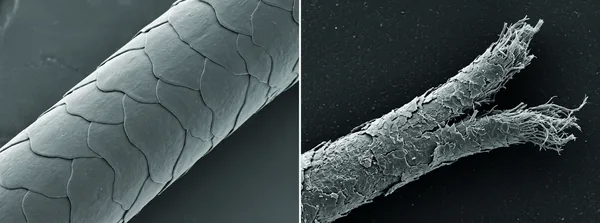
Hair is dead protein, so damage cannot heal. It can only be reduced, smoothed or cut off. Bleach damage is permanent chemistry, heat on wet hair is a common cause, and bond builders (repair products) help in the lab but do not undo it.
See how it works
Do this
- 1Lighten less: fewer sessions, weaker developer (bleach strength), no overlap on bleached lengths.
- 2Dry hair before using irons or tongs; never heat wet hair.
- 3Use the lowest heat that works, with fewer passes.
- 4Condition every wash and detangle wet, working from the ends upward.
- 5If you bleach, add a bond-building treatment as a helper, not a fix.
- 6Trim split ends; no product mends them, and splits can travel up.
The numbers behind it
-
+47.6%
Higher strength of bleached fibres after one bond-builder treatment. Another brand gave 19.5%, not significant (3 hair bundles per group, lab).
-
Up to 40%
Drop in fibre stiffness after each bleaching treatment. Surface roughness change rose by up to 65% with repeat bleaching (lab).
-
Up to 85%
More damage from 'ammonia-free' colours using MEA (an ammonia substitute) than from ammonia ones (Procter & Gamble lab study).
-
56-124%
More cycles to break for chemically treated hair after a citric acid treatment (L'Oreal lab study on cut hair).
For your hair
Bleached or relaxed hair
Weakest when wet. Condition before handling and use the least heat.
Curly and coily hair
Bleach weakens every hair type. Curls also snag easily, so condition well and detangle wet.
Myths to ignore
-
Myth Bond builders re-link the broken bonds in your hair.
Truth An independent test found no extra disulfide (sulfur-to-sulfur) bonds and no direct sign of the claimed reaction. The hair surface did look more regular.
Di 2021 ↗ -
Myth Oils and masks repair split ends.
Truth In bleached or weak hair, splits start inside the fibre and can run far up it (small lab test). Products may hide them; only cutting removes them.
Taylor 2024 ↗ -
Myth Ammonia-free colour is gentle.
Truth In one lab study, colours with MEA instead of ammonia caused up to 85% more damage at the highest MEA levels.
Bailey 2014 ↗ -
Myth Protein treatments rebuild hair.
Truth Hydrolysed keratin (broken-down wool protein) coats hair and partly enters it. Treated hair kept its strength after UV while untreated lost 14.32%. That is UV protection, not rebuilding.
Fan 2025 ↗
Made for this
Go deeper
- Hair damage: what it is and where it comes fromDamage is cumulative and cannot be biologically healed, and chemical treatments, heat, sun, water and grooming each add to it.
- Bleach and colour damageBleaching and permanent dyeing chemically damage the hair fibre in every hair type, and most of that damage cannot be undone.
- Bond builders (Olaplex, K18, maleic acid, "acidic bonding")Bond builder is a marketing label for four unrelated chemistries; all have lab results on cut hair and none has a trial on real heads.
- Split ends and trimmingSplit ends cannot be repaired, only smoothed over or cut off, and trimming preserves length by stopping splits travelling up the strand.
- Proteins and hairHydrolysed proteins can modestly strengthen damaged hair in the lab, but the popular protein-moisture balance rule has never been tested.
- Oils and hairOils coat hair and some enter it, which can cut damage from washing, but they do not repair split ends or add moisture.
- Heat damage and heat protectantsHeat on wet hair is the clearest harm, and there is little independent evidence that retail heat-protectant sprays work.
All studies in this guide (7)
Martins E et al. Bleached hair as standard template to insight the performance of commercial hair repair products. Cosmetics. 2024
Tested: Olaplex No. 0 and K18 leave-in mask versus untreated bleached hair
Result: Olaplex No. 0 raised single-fibre tensile strength by 47.6% (significant); K18 raised it by 19.5% (not significant) and formed an external layer on the fibre.
Read the study ↗Humphry R et al. Site-specific variations in surface structure and Young's modulus of hair surfaces after bleach. J Mech Behav Biomed Mater. 2022
Tested: repeated bleaching
Result: Surface roughness change accelerated with repeat bleaching (up to +65% after 10 more minutes) and stiffness fell by up to 40% after each treatment.
Read the study ↗Bailey AD et al. Comparison of damage to human hair fibers caused by MEA- and ammonia-based hair colorants. J Cosmet Sci. 2014
Tested: monoethanolamine versus ammonia colourants
Result: Colourants with monoethanolamine caused up to 85% more damage than ammonia-based ones.
Read the study ↗Zhang D et al. Reinforcing chemically treated human hair with citric acid. 2025
Tested: citric acid treatment
Result: Citric acid reduced calcium in chemically treated hair by 21-42% and improved mechanical properties.
Read the study ↗Di Foggia M et al. Structural investigation on damaged hair keratin treated with alpha,beta-unsaturated Michael acceptors used as repairing agents. Int J Biol Macromol. 2021
Tested: commercial maleate-type and shikimic-acid repair products and model compounds
Result: No treatment increased disulfide content in the cortex, and the authors found no direct evidence of the claimed thiol-maleate cross-linking, although the cuticle looked more regular.
Read the study ↗Taylor D et al. The biomechanics of splitting hairs. 2024
Result: Split ends form when hair cycles through tangle-like loops; in bleached or low-quality hair splits start inside the fibre.
Read the study ↗Fan J et al. Performance and mechanism of hydrolyzed keratin for hair photoaging prevention. Molecules. 2025
Tested: hydrolysed keratin treatment before UV
Result: Hydrolysed keratin deposited on the cuticle and partly penetrated; treated hair kept its tensile strength after UV while untreated hair lost 14.32%.
Read the study ↗