DETANGLING
How to brush and detangle your hair
The short answer
Detangle with conditioner on, starting at the ends and working up in short strokes. Use a wide-tooth comb or a flexible brush. Curly and coily hair is best detangled wet, never dry. Skip the 100 strokes.
See how it works
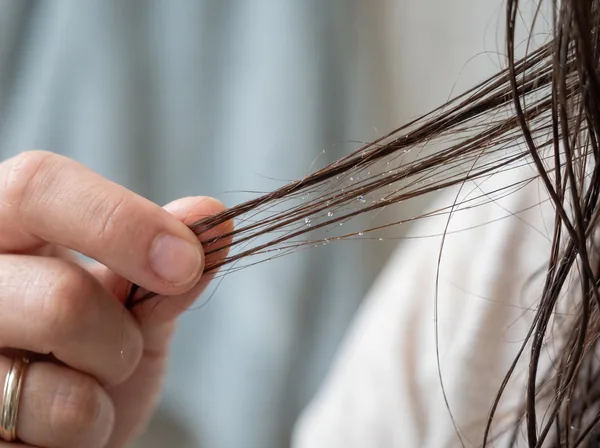
Do this
- 1Put conditioner or leave-in on first. Slip (glide) is what protects hair.
- 2Start at the ends and work up in short strokes.
- 3Use a wide-tooth comb, or a flexible-bristle brush.
- 4Hit a knot? Stop and loosen it with your fingers.
- 5Curly or coily: detangle damp or wet, in sections. Never dry.
- 6Brush only to style. Do not brush for the sake of it.
The numbers behind it
-
100% to under 10%
Chance of a hard snag when combing wet bleached hair fell from 100% to under 10% with conditioner (lab hair bundles).
-
16 strokes
The average woman surveyed (231 women) combs about 16 strokes a day, not 100.
-
480 strokes
On afro hair, 480 combing strokes damaged the outer layer (cuticle) more than frequent braiding. Damage rose steadily with strokes.
-
More long breaks
Brushing gave a higher share of long breaks than combing in lab hair bundles, the largest effect of all factors tested.
For your hair
Straight and fine hair
Be gentle with soaking wet hair. Comb after conditioner, or once it is damp rather than dripping.
Wavy hair
Detangle in the shower with conditioner in. Brushing dry waves breaks up the pattern.
Curly and coily hair
Damp or wet, plenty of conditioner, in sections, ends first. Dry combing is a classic cause of breakage.
Bleached or relaxed hair
Most fragile when wet. Always condition before combing.
Myths to ignore
-
Myth Brushing 100 strokes a day makes hair healthy.
Truth More strokes means more cuticle damage. On afro hair the damage rose in a straight line with strokes. Typical use is about 16 strokes a day.
Molamodi 2021 ↗ -
Myth Never comb wet hair.
Truth Wet combing breaks hair in different places, higher up the strand, rather than always more. With conditioner it is the standard advice for curly hair.
Robbins 2007 ↗ -
Myth A boar bristle brush spreads scalp oil and makes hair healthy.
Truth Nobody has measured this. A 2025 dermatology guide repeats it without data, and also notes misused brushes can cause breakage.
Williams 2025 ↗
Made for this
Go deeper
- Brushing and detanglingMost combing damage comes from tangles, so conditioner and the right technique cut breakage more than the choice of brush.
- Hair myths, checkedTwenty-five popular hair beliefs checked against the evidence, from shaving to biotin to baldness genes.
- Traction and hairstylesTight, long-worn styles can cause traction alopecia, which reverses if caught early and scars if it is not.
- How conditioner worksRinse-off conditioner coats hair with a positively charged layer that cuts friction and tangling; it does not repair structural damage.
All studies in this guide (5)
New S et al. Measuring the frequency of consumer hair combing and magnitude of combing forces on individual hairs in a tress and the implications for product evaluation and claims substantiation. 2018
Result: Women combed about 16 strokes a day; wet bleached hair snagged every time and conditioner cut that to under 10%.
Read the study ↗Molamodi K et al. Quantifying the impact of braiding and combing on the integrity of natural African hair. 2021
Result: Frequent braiders had thinner, weaker hair with more cuticle damage; cuticle damage grew with combing strokes; industry-run.
Read the study ↗Robbins C et al. Hair breakage during combing. IV. Brushing and combing hair. 2007
Result: Long breaks increase with bleaching, longer strokes, curlier fibres, wet combing and especially brushing.
Read the study ↗Robbins C et al. Hair breakage during combing. III. The effects of bleaching and conditioning on short and long segment breakage by wet and dry combing of tresses. 2007
Result: Dry combing breaks the ends more per stroke; wet combing breaks hair higher up; conditioner reduced both short and long breaks.
Read the study ↗Williams KN et al. Hairbrushes: A Guide for Dermatologists. 2025
Result: Dermatology guide to ten brush types: expert recommendations only, no comparative trials.
Read the study ↗