CURLS
Curly and wavy hair care, simply
The short answer
Shampoo the scalp, not the lengths, and condition the lengths every wash. Detangle wet, never dry. Apply gel to soaking-wet hair, leave it untouched until fully dry, then scrunch out the crunch.
See how it works
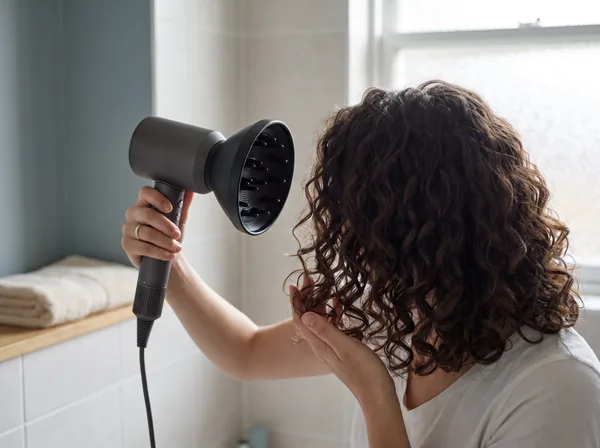
Do this
- 1Shampoo the scalp, condition the whole length, detangle while conditioner is in.
- 2Never brush dry curls; use fingers or a wide-tooth comb on wet hair.
- 3Blot with a T-shirt or microfiber wrap (plopping); do not rub.
- 4Put gel or cream on soaking-wet hair, then do not touch it.
- 5Once fully dry, scrunch gently to break the gel cast (crunchy shell).
- 6Between washes, mist lightly and re-scrunch instead of re-washing.
The numbers behind it
-
35.3%
Chemically relaxed hair broke under 35.3% less force at 80% humidity than at 20%. Untreated hair showed no clear change (50 fibres per group).
-
40% to 85%
Water taken up by hair rose steadily as humidity went from 40% to 85% (lab test on dark brown and bleached hair).
-
About 1 week
Dandruff and itch returned to peak about a week after washing in 60 women with afro-textured hair (L'Oreal study).
-
45% vs 17%
Wear resistance (how well hair held up) of over-bleached hair: microfiber wrap versus cotton towel. 3 repeats; an author is linked to a towel brand.
For your hair
Wavy hair
Use a lighter leave-in and gel. Heavy creams weigh waves down.
Curly hair
Shampoo the scalp every 3 to 7 days. Oil travels poorly down curls, so the lengths dry out first.
Coily hair
About weekly, and at the very least every 2 to 3 weeks (AAD). Wash in sections to limit tangles.
Myths to ignore
-
Myth Plopping and microfiber towels are proven to improve curls.
Truth No controlled trial exists. One small lab test on over-bleached hair favoured microfiber, but an author is tied to a towel brand. A soft T-shirt works.
Carvalho 2023 ↗ -
Myth Curly hair should almost never be washed.
Truth Dermatologists say at least every 2 to 3 weeks. In one trial, scalp dandruff and itch returned within about a week of washing.
Fajuyigbe 2024 ↗ -
Myth Humectants like glycerin always add moisture.
Truth Hair takes up water from the air, and humidity changes how curly hair feels. We found no hair study backing the popular glycerin-in-medium-humidity rule.
Skedung 2021 ↗ -
Myth Dry brushing curls is fine if you add product first.
Truth Dry combing breaks the ends more per stroke. Wet combing breaks hair higher up. Conditioner reduced both kinds of breakage.
Robbins 2007 ↗
Made for this
Go deeper
- Styling techniques for curly and wavy hairGentle, moisture-focused handling of curly hair is well supported, but specific techniques and the Curly Girl Method as a package have never been tested.
- Curl patternHow straight, wavy, curly or coily your hair is gets decided in the follicle, mostly by genes, and it shapes shine, tangling, breakage and how a routine should be built.
- FrizzFrizz comes from a rough, damaged surface and moisture uptake; products manage it, while less damage prevents it.
- Humectants and humidityHair swells and softens with humidity, but the popular rules about glycerin and humidity have not been tested; panthenol is the humectant with the best fibre data.
- Caring for hair by porosityMatching products to low, normal or high porosity is common advice, but almost none of it has been tested in people.
- How often to wash your hairYour scalp sets how often you need to wash and your hair lengths set how rarely you can, so the right number depends on your hair type and scalp.
- Brushing and detanglingMost combing damage comes from tangles, so conditioner and the right technique cut breakage more than the choice of brush.
All studies in this guide (6)
Malinauskyte E et al. Penetration of different molecular weight hydrolysed keratins into hair fibres and their effects on the physical properties of textured hair. Int J Cosmet Sci. 2021
Tested: single-fibre tensile tests at 20% vs 80% relative humidity
Result: Untreated relaxed hair broke at 35.3% lower stress at 80% than at 20% relative humidity, while virgin hair showed no significant humidity difference; no fully wet tests were done.
Read the study ↗Gao T. Evaluation of hair humidity resistance/moisturization from hair elasticity. J Cosmet Sci. 2007
Result: Hair frizz was measured by photographing tresses at controlled humidity; naturally curly and kinky hair was the frizziest.
Read the study ↗Fajuyigbe D, et al. Weekly hair washing: the recommended solution for women with afro-textured hair to alleviate dandruff and scalp discomfort. J Dermatol. 2024
Result: In South African women with afro-textured hair, dandruff and itch returned to their peak about a week after washing.
Read the study ↗Carvalho et al. Comparison of cotton towel, microfiber towel and blow-dryer drying on bleached hair. J Nat Fibers. 2023
Tested: 7-minute cotton towel wrap vs microfiber wrap vs blow-dryer at 60-80 C, 8 repeats
Result: Wear resistance was 45% for microfiber vs 17% for cotton and 10% for the blow-dryer (3 replicates each); an author is affiliated with a microfiber hair-towel brand and no conflict is declared.
Read the study ↗Skedung L et al. A Curly Q: Is Frizz a Matter of Friction? Perception. 2021
Result: Rising humidity raised perceived frizz in curly hair partly by changing friction.
Read the study ↗Robbins C et al. Hair breakage during combing. III. The effects of bleaching and conditioning on short and long segment breakage by wet and dry combing of tresses. 2007
Result: Dry combing breaks the ends more per stroke; wet combing breaks hair higher up; conditioner reduced both short and long breaks.
Read the study ↗