Topic
Styling techniques for curly and wavy hair
Gentle, moisture-focused handling of curly hair is well supported, but specific techniques and the Curly Girl Method as a package have never been tested.
Key takeaways
- Curly textured hair is structurally prone to breakage and tangling. Traction alopecia and acquired trichorrhexis nodosa commonly occur in curly textured hair, and styling practices likely contribute (Geisler 2024). Gentle handling is not just cosmetic.
- Wash less, and condition all lengths. The American Academy of Dermatology advises washing thick, curly hair at least every 2 to 3 weeks as needed, shampooing the scalp, conditioning the whole length, then adding oil or a leave-in. Washing too often can leave curly hair dry, frizzy and hard to manage. An oily scalp may need more frequent cleansing (see washing frequency).
- Detangle wet, with conditioner, in sections. Use fingers or a wide-toothed comb, never a brush on dry curls. A professional educator brushes wet, conditioned textured hair while holding the mid-lengths to avoid root tension. Both agree on wet hair plus slip.
- Definition comes from product on wet hair, applied evenly, then left alone to set. The professional wash-and-go sequence is leave-in and moisture product from the ends toward the mid-lengths and lightly at the roots, in horizontal sections from the nape up, without touching curls once placed.
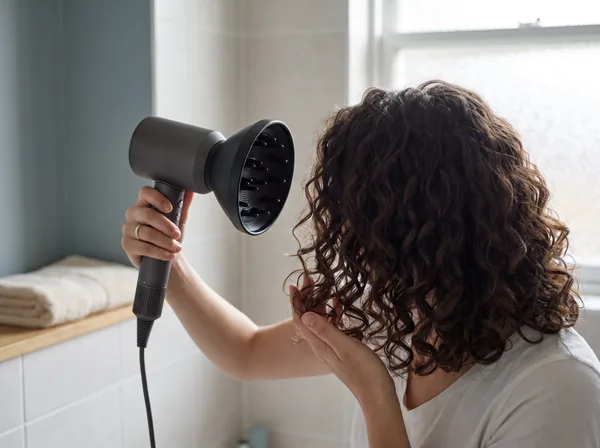
- Diffusing: a diffuser on high heat with low airflow, hair placed in the bowl and left alone, then oil and a gentle shake-out at roughly 80 to 95% dry. Diffuser settings are untested. The American Academy of Dermatology limits heat to low or medium.
- Humidity changes frizz. In a L'Oreal laboratory study, humidity disproportionately changed perceived frizz of curly hair by touch through changes in friction (Skedung 2021). Humidity-resistant gels and creams are designed for this (Keenan 2011).
- Night care: sleep in a loose ponytail on top of the head or a loose braid, or use a satin pillowcase, to reduce friction.
- The Curly Girl Method is mostly sensible but rule-heavy. Sulfate avoidance, no heat, no dry brushing, co-washing and no silicones have partial support or none (table below).
The Curly Girl Method, rule by rule
| Rule (as commonly stated) | What the evidence says |
|---|---|
| No sulfate shampoos | Sulfates clean sebum and buildup well. Milder or sulfate-free cleansers are reasonable for dry, fragile or irritated curls. A dermatology review frames sulfate and paraben fears as largely internet-driven but acknowledges patient concerns (Cline 2018). |
| No silicones | Silicones reduce friction and add shine and heat protection, but can build up. Newer water-dispersible types exist. Neither good nor bad categorically (Carvalho 2025). |
| Co-wash (wash with conditioner) | Gentle, but may leave residue under the cuticle scales. A dermatology paper discusses pros and cons (Gavazzoni Dias 2019). Dermatologists still advise shampooing the scalp at least every 2 to 3 weeks. |
| No brushes, finger-detangle only | Gentle detangling on wet, conditioned hair agrees with dermatology advice, and a wide-toothed comb is accepted. A strict "never brush" is a popular rule. |
| Avoid heat | Consistent with dermatology advice and lab data (see heat styling tools). |
| Plopping, microfiber towels, scrunching | No controlled data. A small lab study favoured a microfiber wrap on over-bleached hair, with a conflict of interest (see hair drying). |
| Clarify monthly | Dermatologists suggest a clarifying shampoo if you use gels, oils, creams or pomades. The monthly schedule is stylist practice. |
The method gathers real dermatology advice (gentle handling, moisture, less heat) and some rules that are preference, not science.
Why curls behave as they do
- Bends and twists are weak points where cracks and knots form (see curl pattern).
- Tighter curls are usually advised more moisture and conditioning and less brushing, but this rests on mechanism and clinical experience rather than trials (Humphrey 2026).
- Curly hair shrinks as it dries. We found no study quantifying shrinkage by curl pattern. Stylists treat it as normal and plan length accordingly.
Technique summary (professional practice)
- Cleanse and condition, with a deep-conditioning mask under a cap for around 10 minutes when needed.
- Detangle wet with slip, in sections.
- Apply leave-in and a curl cream or gel to very wet hair, spread it evenly with a brush, "prayer hands" or fingers, and mist to avoid frizz.
- Scrunch for volume. Skip scrunching if you want length.
- Dry by diffusing or air drying, without touching. Use a hooded dryer if you do not want maximum volume.
- Break the cast once the hair is about 80 to 95% dry: add a little oil and shake or scrunch gently.
- Refresh between washes with water, leave-in or a light cream.
Wavy (2A to 2C) hair
- Waves collapse under heavy products. Light mousse, foam or cream on damp hair, diffused or air-dried, usually gives definition without weight.
- Over-brushing turns waves to frizz.
What it means by hair profile
- 2A to 2C: light products, root lift, and diffusing upright to avoid flattening.
- 3A to 3C: leave-in plus gel or cream, scrunch, refresh daily.
- 4A to 4C: moisture first, thick creams, twist-outs or wash-and-go, and protect the ends. Avoid tight styles and glue (see traction and hairstyles). Afro-textured hair is vulnerable to traction and central centrifugal cicatricial alopecia, and the role of chemical relaxers and heat is mixed (Geisler 2024).
- Fine strands: conditioner on the ends only and light products. Thick strands: full-length conditioner and richer creams.
- Low density: do not over-clump, and root volume helps.
- High porosity: sealing leave-ins and oils help. Low porosity: lighter products and warmth when conditioning (see hair porosity).
- Oily or dandruff scalp: shampoo the scalp more often and apply dandruff shampoo to the scalp only.
Myths and facts
- Myth: curly hair should not be washed. Fact: dermatologists say at least every 2 to 3 weeks, and dandruff and oily scalps need more.
- Myth: all sulfates and silicones are bad for curls. Fact: context matters (see the table).
- Myth: heavy oils define curls. Fact: no evidence, and oils can build up and weigh hair down.
- Fact: gentle handling lowers breakage. The evidence supports the principle but not each step.
Practical recommendations
- Test one change at a time for 4 to 6 weeks. Trial and error is normal.
- Condition every wash and detangle wet.
- Apply gel or cream to wet hair in sections, and do not touch it as it dries.
- Break the cast only when the hair is dry.
- Protect your hair at night with satin or a loose braid.
- Use heat sparingly.
- Clarify as needed if you use heavy products.
- Choose a stylist who cuts curls (see talking to your barber or stylist).
Bottom line
Gentle handling, moisture and less heat are well supported for curly hair, and the Curly Girl Method wraps those in some rules that are preference rather than evidence. Treat the technique steps as professional practice and change one thing at a time to see what your hair likes.
Studies 7
Geisler AN et al. Updates on disorders in curly hair. 2024
Result: Review of hair care practices: high-tension styles cause traction alopecia and grooming drives trichorrhexis nodosa.
Read the study ↗Humphrey JG et al. Afro-textured hair care: a narrative review and recommendations for dermatologists. Int J Womens Dermatol. 2026
Result: Narrative review: mechanism and clinical experience support more moisture and gentler handling for tighter curls; training and terminology gaps affect care.
Read the study ↗Skedung L et al. A Curly Q: Is Frizz a Matter of Friction? Perception. 2021
Result: Rising humidity raised perceived frizz in curly hair partly by changing friction.
Read the study ↗Keenan AC, Antrim RF, Powell T. Characterization of hair styling formulations targeted to specific multicultural needs. J Cosmet Sci. 2011
Tested: three formulations tested for stiffness, shine, humidity curl control and UV
Result: Tailored formulas achieved anti-frizz, humidity resistance and style control across hair types.
Read the study ↗Cline A, Uwakwe LN, McMichael AJ. No sulfates, no parabens, and the 'no-poo' method: a new patient perspective on common shampoo ingredients. Cutis. 2018
Result: Frames the no-sulfate, no-paraben and no-poo trends as patient-driven and urges dermatologists to address them with facts; no outcome data.
Read the study ↗Gavazzoni Dias MFR. Pro and Contra of Cleansing Conditioners. Skin Appendage Disord. 2019
Result: Co-washing is gentle to hair but prone to residue under the cuticle.
Read the study ↗Show 1 more studies
Carvalho RM, Melo DF, Kelati A, Tosti A. With or without silicones? A comprehensive review of their role in hair care. Skin Appendage Disord. 2025
Tested: silicones in hair care
Result: Silicones reduce friction, prevent moisture loss and add shine and heat protection, with build-up concerns for water-insoluble types; newer water-dispersible forms exist.
Read the study ↗Related
- Curl patternHow straight, wavy, curly or coily your hair is gets decided in the follicle, mostly by genes, and it shapes shine, tangling, breakage and how a routine should be built.
- Hair porosityPorosity describes how easily water moves in and out of a hair fiber; in practice it is mostly a marker of damage, and the popular float test does not measure it.
- Brushing and detanglingMost combing damage comes from tangles, so conditioner and the right technique cut breakage more than the choice of brush.
- Traction and hairstylesTight, long-worn styles can cause traction alopecia, which reverses if caught early and scars if it is not.
- Heat styling toolsFlat irons, curling tools and hot combs damage hair more with higher temperature, repetition and wet hair; dermatologists advise using them about once a week or less.
- Styling products explainedStyling products come down to how much hold and how much shine you want; there are almost no head-to-head trials, so this page combines formulation knowledge with the few things that have been measured.
- Silicones in hair careSilicones coat hair to cut friction and add shine without repairing it; buildup is real but manageable, and the scare claims are unsupported.
- How often to wash your hairYour scalp sets how often you need to wash and your hair lengths set how rarely you can, so the right number depends on your hair type and scalp.
- Talking to your barber or stylistNo study tests how to brief a barber, so the consultation checklist is professional practice, while the health parts (scalp checks, tool hygiene) have small peer-reviewed support.