Topic
Heat styling tools
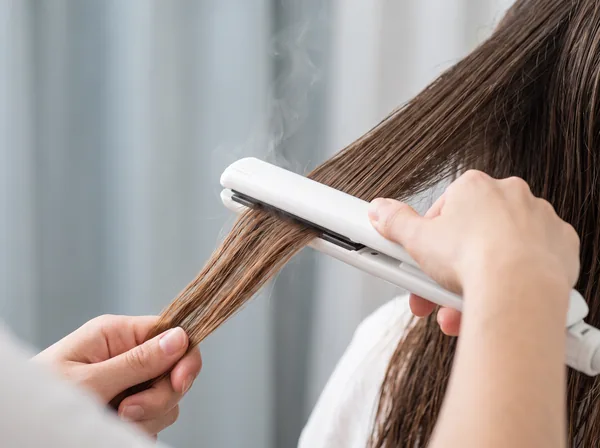
Flat irons, curling tools and hot combs damage hair more with higher temperature, repetition and wet hair; dermatologists advise using them about once a week or less.
Key takeaways
- Heat damages protein and the cuticle, and damage rises with temperature, repetition and dwell time. In lab thermal analysis of cut virgin hair tresses (not a styling-tool test), water left the fibre at 25-170 C, decomposition gases appeared from 200 C, and keratin denatured at about 237 C. Asian hair lost more protein than Caucasian hair (Lima 2019, 3 tresses per condition).
- How slowly the iron moves matters as well as the dial. The principle that slower passes transfer more heat fits the American Academy of Dermatology advice to leave a curling iron on for only a second or two. We could not open the laboratory series that gives exact temperature figures, so we do not quote any.
- Do not flat-iron wet or damp hair. In a University of Manchester study, hair treated while wet, or with a water-based heat-protection spray, showed more structural damage and bigger drops in stiffness than dry hair, even though the chemical (tryptophan) damage was similar. Rapid evaporation of water is the likely cause (Christian 2011).
- Heat protectants help a little. In the same study, tryptophan damage fell with repeated applications of water-based and alcohol-based sprays (Christian 2011). No study measures how much a protectant reduces visible breakage in real use.
- A heat-damage scale now exists. A 2025 study proposed a 6-point scale from single-fibre tensile tests, applied it to on-market straighteners, and found it matched how people perceived damage on tresses (Shaw 2025). The authors work for a company that tests hair tools.
- Real users show a microscopic footprint. In 94 women, those who had blow-dried, ironed, straightened or permed in the previous 6 months had no difference in hair breakage index or density, but much higher odds of microscopic hair-shaft changes (OR 22.0, 95% CI 4.3 to 112.6) (Malkani 2020). It is a cross-sectional study of young women with a wide interval.
- Colour, bleach and straightening add to heat damage. Bleaching and dyeing damaged hair independently of curl pattern, and heat and UV added to that (Bloch 2019).
- Dermatology advice is consistent: heat tools about once a week or less, the lowest setting that works, and air drying whenever possible. For thicker, coarser hair the American Academy of Dermatology notes a higher setting may be needed, and it recommends ceramic irons with a temperature dial for Black hair care.
What the studies show
| Study | Year | Design | n | Main result |
|---|---|---|---|---|
| Lima et al. | 2019 | Lab thermal analysis of cut Caucasian and Asian virgin hair (no styling tool) | 3 tresses per group | Water loss 25-170 C; gases from 200 C; denaturation about 237 C; more protein loss in Asian hair |
| Christian et al. | 2011 | Straightening irons on tresses, wet vs dry, with protectant sprays | tresses | Wet hair and water-based spray gave more structural damage; protectants reduced tryptophan damage |
| Lee et al. | 2011 | Dryer at 47, 61 and 95 C, 30 cycles | tresses | Cuticle damage rose with temperature; cortex spared. See hair drying |
| Shaw et al. | 2025 | Single-fibre tensile metric, 6-point scale | n/a | Scale correlated with perceived damage; company authors |
| Malkani et al. | 2020 | Cross-sectional | 94 women | Microscopic changes with styling procedures; no change in breakage index |
| Bloch et al. | 2019 | Treatments across five hair types | tresses | Bleach and dye most aggressive; heat and UV added damage |
In plain words, hair is mostly keratin. Heat dries it and loosens the bonds so it can be reshaped, and above a threshold it starts to denature the protein and crack the cuticle scales. Water trapped in the fibre can flash to steam when an iron meets damp hair, which adds structural damage.
What is not known: how many passes at what temperature cause visible damage in living hair, whether ionic, ceramic or titanium plates differ in a way that matters (we found no independent test), and the safe temperature for fine versus coarse hair.
What it means by hair profile
- Fine hair: fine strands heat and weaken faster and show breakage first, so keep temperatures lowest. This is stylist practice.
- Coarse or thick hair: tolerates more heat per pass, but still takes damage cumulatively.
- Curl pattern 3A to 4C: straightening reduces shrinkage and tangles, but heat damage can show as curls that no longer spring back, plus dryness. Heat and chemical relaxers are cited as hair-care risks, though data on their role in central centrifugal cicatricial alopecia are mixed (Geisler 2024). Limit use to about once a week and protect the ends.
- Bleached, coloured or chemically straightened hair: treat as already damaged. Use lower temperature and fewer passes, or switch to heatless styling.
- High porosity: loses water quickly and takes heat damage more easily. This is mechanism, not a measured result.
- Dry or flaky scalp: keep hot air and plates away from the scalp.
Myths and facts
- Myth: ceramic or tourmaline plates make an iron safe. Fact: plate material did not feature in any independent study we opened. Temperature, contact time and hair condition did.
- Myth: heat protectant makes heat harmless. Fact: it reduced one chemical marker in a lab model and does not remove damage.
- Myth: you can flat-iron wet hair if the iron is a steam iron. Fact: water plus heat gave more structural damage than dry hair in a controlled test.
- Myth: straightening with heat causes cancer. Fact: there is no evidence for heat. A cohort study of 33,947 women linked chemical straighteners, not dyes or perms, to uterine cancer (HR 1.80, and 2.55 with frequent use) (Chang 2022). It is observational and does not isolate a chemical. Salons using formaldehyde-based treatments can raise airborne formaldehyde (Henault 2021, L'Oreal authors; Weathersby 2013). Those are chemical risks, not heat-tool risks.
Practical recommendations
- Dry first, then iron. Hair should be completely dry. Blow-dry on low or air dry.
- Use the lowest temperature that gives the shape. Start low and raise only if needed.
- Avoid parking the iron on one spot. For curling tools, think seconds, not minutes.
- Apply a heat protectant or a leave-in labelled as one, and let it dry.
- Limit frequency to about once a week or less.
- Choose a device with a temperature dial.
- Condition after every wash and trim damaged ends, since split ends cannot be repaired.
- Stop if hair feels brittle or rough or smells of burning, and rest it for weeks.
- Skip heat on bleached or chemically straightened hair if you can.
Bottom line
Heat damage is cumulative and depends on temperature, repetition and wetness, so the lowest setting, dry hair and a weekly limit at most are the evidence-backed habits. Protectants and fancy plates are not proven to change the outcome.
Studies 10
Lima CRRC et al. Heat-damaged evaluation of virgin hair. J Cosmet Dermatol. 2019
Tested: laboratory thermal analysis of hair (TG/DSC-MS, FTIR, ATR-FTIR, SEM); no styling tool used
Result: Water was released at 25-170 C, CO2, SCO and H2S from 200 C, and keratin denatured at about 237 C. Asian hair lost more protein than Caucasian hair. Lab thermal analysis, not a styling-tool test.
Read the study ↗Christian P et al. The effects of water on heat-styling damage. J Cosmet Sci. 2011
Result: Heat styling wet hair caused considerably more structural damage than heat on dry hair, and a water-based heat-protection spray did worse than an ethanol-based one.
Read the study ↗Lee Y et al. Hair shaft damage from heat and drying time of hair dryer. 2011
Tested: air drying vs dryer at 47, 61 and 95 C
Result: No cuticle damage in air-dried hair; every dryer setting cracked cuticle, worse with heat; cell membrane complex bulging only in air-dried hair; qualitative, no statistics.
Read the study ↗Shaw N et al. Application of single hair fibre tensile measurements to create an industry-standard heat damage scale for hair. Int J Cosmet Sci. 2025
Result: A 6-point heat damage scale built from eight wet single-fiber measures tracked how people perceived damage on tresses.
Read the study ↗Malkani RH et al. Hair Styling Procedures and Hair Morphology: A Clinico-Microscopic Comparison Study. 2020
Result: Recent blow-drying, straightening, ironing or perming went with many more microscopic shaft changes (OR 22) but not different breakage index or density.
Read the study ↗Bloch LD et al
Result: Chemical and physical treatments such as bleach, UV and flat ironing damaged both Caucasian and Afro-ethnic hair fibers.
Read the study ↗Show 4 more studies
Geisler AN et al. Updates on disorders in curly hair. 2024
Result: Review of hair care practices: high-tension styles cause traction alopecia and grooming drives trichorrhexis nodosa.
Read the study ↗Chang CJ et al. Use of straighteners and other hair products and incident uterine cancer. J Natl Cancer Inst. 2022
Tested: hair dye, straighteners, perms
Result: Hair dye was not linked to uterine cancer; straightener use was (HR 1.80, 2.55 with frequent use). Observational; does not isolate a chemical.
Read the study ↗Henault P et al. Quantifying aerial formaldehyde released by some hair treatments. J Air Waste Manag Assoc. 2021
Tested: formaldehyde-based hair treatments
Result: Some treatments released airborne formaldehyde.
Read the study ↗Weathersby C, McMichael A. Brazilian keratin hair treatment: a review. J Cosmet Dermatol. 2013
Tested: Brazilian keratin treatments
Result: Reviews formaldehyde release and safety concerns of keratin straightening treatments.
Read the study ↗Related
- Hair dryingAir drying is not clearly safer than moderate-heat blow-drying; high heat, close range and heat on wet hair are the real problems.
- Heat damage and heat protectantsHeat on wet hair is the clearest harm, and there is little independent evidence that retail heat-protectant sprays work.
- Hair damage: what it is and where it comes fromDamage is cumulative and cannot be biologically healed, and chemical treatments, heat, sun, water and grooming each add to it.
- Styling techniques for womenNo trial tests how to style women's hair, so these blow-dry, heatless and low-tension techniques are professional practice; the perception studies say healthy-looking hair beats any specific style.
- Styling techniques for curly and wavy hairGentle, moisture-focused handling of curly hair is well supported, but specific techniques and the Curly Girl Method as a package have never been tested.
- Relaxers, perms and smoothing treatmentsChemical straighteners and perms all damage hair, and some carry scalp, respiratory, kidney or cancer-association concerns worth knowing before you book.
- Hair colour for looksGray hair lowered attractiveness ratings in image swaps and blonde versus brunette results conflict; dyeing damages hair, PPD allergy is the real dye risk, and personal dye use has not been shown to cause cancer.