Topic
Hair drying
Air drying is not clearly safer than moderate-heat blow-drying; high heat, close range and heat on wet hair are the real problems.
Key takeaways
- No controlled human study compares drying methods. Almost everything comes from lab tests on cut tresses, often run by cosmetics companies, and from case reports. Treat all drying advice as low-certainty.
- Air drying is not "worse" than blow-drying. The study usually quoted (Lee 2011) found no cuticle surface damage in air-dried hair, while every dryer setting cracked the cuticle, more so with heat. Its only finding against air drying was swelling of the cell membrane complex, the glue between cells, on electron microscopy of single tresses with no statistics. The authors' preference for a dryer at 15 cm was their reading of a trade-off, not a measured overall result. Lee 2011
- If you use a dryer, distance and heat matter most. In that study damage scaled with temperature (47 C at 15 cm, then 61 C at 10 cm, then 95 C at 5 cm), and the hottest setting punched holes in the cuticle.
- Never put high heat on wet or damp hair. Water inside the fibre can boil and leave gas bubbles ("bubble hair"), making hair brittle and prone to snapping. In lab heating of hair from 16 volunteers, every volunteer's hair bubbled at high enough heat. Detwiler 1994 Cases have followed overheating dryers, flat irons used on wet hair and even a bathroom heat lamp.
- Wet hair is not simply "weaker". Water plasticizes the fibre so it breaks at a lower load, and raises friction. Handle wet hair gently and use conditioner before detangling. Robbins 2007
- Blot and squeeze rather than rub. This is mechanically sensible, but no study has compared rubbing with blotting.
- Microfiber towels are weakly supported: one small lab study on over-bleached hair favoured a microfiber wrap, but an author is affiliated with a microfiber hair-towel company. A soft T-shirt or smooth towel used gently is a fine budget option. Carvalho 2023
- Ionic dryers and diffusers have no peer-reviewed evidence for hair health, and "hygral fatigue" from repeated wetting is unproven for healthy hair.
What water does to your hair
Wet hair is the weakest hair you will handle all day, so drying is where much of the avoidable damage happens. All of this is lab work on cut fibres and tresses, not trials on people.
- Water softens the fibre from the inside. In single-fibre tests, untreated hair soaked in water had a modulus (stiffness) of 1.89 GPa versus 3.95 GPa dry, about half. It broke at 191 MPa wet versus 229 MPa dry (17% lower) and stretched 57.5% before breaking versus 46.9% dry. Twice-bleached hair was weaker still when wet (167 MPa, 1.63 GPa). About 30 fibres per tress, one hair batch. Wortmann 2022
- The cause is plasticization: water gets into the protein matrix, so dry hair's glass transition of about 144 C falls, and hair is far above its transition when soaked. Wortmann 2006 Hair sorption data suggest the inner structure starts opening near 30% relative humidity and softens at 60-70% (employer-run study). Breakspear 2022
- Water swells the glue between cuticle cells (the cell membrane complex) by about 10% in thickness. Kreplak 2001 Fibres fail along this glue, and wet failures run through its water-loving layers. Robbins 2004
- Even humid air matters: chemically relaxed textured hair broke at 35.3% lower stress at 80% than at 20% relative humidity, while virgin hair showed no significant difference (50 fibres per group, no fully wet test). Malinauskyte 2021
- Wet hair also snags more. Wet combing broke hair higher up the tress, from higher friction and lower break load. Robbins 2007 In 231 women, wet bleached hair snagged every time and conditioner cut that to under 10%. New 2018
- What we do not know: whether repeated wetting alone ("hygral fatigue") harms healthy hair is a proposed mechanism, not a demonstrated result, and no study has compared towel rubbing with blotting or sleeping with wet hair against dry. Ruetsch 2001
The science
Hair is a water-absorbing keratin fibre. Water swells it mostly in diameter and temporarily loosens the hydrogen bonds that hold its shape, which is why wet hair stretches more and re-wetting undoes a heat style. Breakspear 2024 In combing tests wet hair had higher friction and snagged higher up the tress. Robbins 2007 Wet strands also clump through capillary forces, which reduced short breaks at the tips. Bico 2004
Air drying versus blow-drying, Lee 2011: chemically untreated hair, shampooed and dried once a day for 30 days. Air-dried tresses (over 2 hours to dry) showed no surface cracks; dryer tresses showed cracks at 47 C, more at 61 C and holes at 95 C. Cell membrane complex bulging appeared only in the air-dried group. Moisture content did not differ between groups. Two authors work at a Korean consumer-goods company. This is one small, qualitative experiment; it shows heat damages the cuticle in proportion to temperature and closeness, not that blow-drying is healthier overall. Lee 2011
Bubble hair is an acquired defect with gas-filled cavities in the shaft. Brief, focal heating of damp hair is enough to cause it. Gummer 1994 A 2023 review of 11 case reports found most patients had used a heated tool on wet hair, and treatment is stopping the heat. Li 2023 Other cases followed a flat iron used on wet hair Savitha 2011 and a bathroom heating lamp. Wu 2025 In lab tests, cycles of a curling iron on wet hair produced cuticle bulges and cracks from escaping steam, worse with more cycles. Ruetsch 2004
Cumulative heat: a 2025 industry-run lab model of a month of daily blow-drying found lifted cuticles, lower water content, weaker mechanics and more protein loss. Zi 2025 Cycles of shampooing, blow-drying and sunlight stripped 18-MEA, the water-repelling fatty acid on the cuticle. Wiesche 2011 In 94 Indian women, recent blow-drying, straightening, ironing or perming went with far more microscopic shaft changes (OR 22), but not with different breakage index or density; blow-drying was lumped with harsher procedures. Malkani 2020 In a bundle of hair, heat takes minutes rather than seconds to reach the centre, so blasting thick hair over-heats the outer layer long before the inside is dry. Petrovicova 2019
Microfiber: on hair bleached eight times, a 7-minute microfiber wrap scored 45% wear resistance versus 17% for cotton and 10% for a blow-dryer at 60-80 C, with 3 replicates each. The hair was over-bleached, the replicates tiny and the conflict undeclared, so it is weak evidence. Carvalho 2023
What it means by hair profile
- Fine, straight hair: dries quickly, so wet time is short. If blow-drying, the lowest heat that works is enough. Wet virgin hair snagged more than dry hair in combing tests, so be gentle while wet. New 2018
- Thick, coarse or dense hair: can take hours to air-dry and heat penetrates slowly. A reasonable compromise is to blot, let it partly air-dry and finish on low or medium heat while keeping the dryer moving. This compromise is untested.
- Curly and coily hair: air drying or a diffuser on low heat preserves definition. Rubbing with a towel causes frizz and snags. Never use a flat or curling iron on damp hair. Detangle wet with conditioner (see brushing and detangling).
- Bleached, chemically treated or high-porosity hair is the most vulnerable. Wet bleached hair snagged on every combing run, but conditioner cut that to under 10% of runs. New 2018 Minimise heat and condition before handling.
- Long hair: more length means more tangles and a longer drying time, and combing breakage rises with fibre length and stroke length. Robbins 2007
Myths and facts
- Air drying is always healthiest: mostly true for the cuticle, unproven overall.
- Blow-drying at a distance is healthier than air drying: overstated; the same study found more surface damage at every dryer setting.
- Never use heat on wet hair: true for high, focal heat.
- Rubbing with a towel damages hair: plausible, untested.
- Microfiber towels prevent damage: weak evidence.
- Ionic dryers make hair healthier: no evidence.
- Frequent wetting causes hygral fatigue: unproven.
Practical recommendations
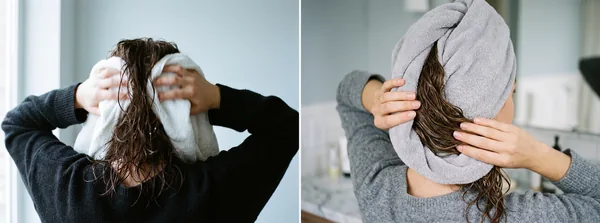
- Remove water gently: squeeze and blot with a towel or soft T-shirt. Dermatology guidance lists rubbing hair dry among damaging habits.
- Detangle only with slip: apply conditioner or a leave-in first, start at the ends and use a wide-tooth comb or flexible-bristle brush.
- If you blow-dry, use the lowest heat that works, keep the nozzle at least 15 cm away, keep it moving and stop when the hair is just dry. Letting hair partly air-dry first cuts heat exposure. This is common advice, not tested.
- Never use flat or curling irons on wet or damp hair, and do not hold a dryer on one spot. Dermatology guidance also advises limiting heat styling to about once a week or less if hair is damaged.
- Avoid staying soaking wet for hours, for example by going to bed with dripping hair (see sleep and hair).
- Budget: free (gentle technique, an old T-shirt); mid (a microfiber towel, optional); premium (a dryer with temperature control, which matters more than "ionic" marketing).
Bottom line
Keep heat low and far from the hair, never apply it to wet hair with irons, and handle wet hair gently with conditioner. Air drying is fine but not proven safer. Discuss with a doctor.
Studies 24
Lee Y et al. Hair shaft damage from heat and drying time of hair dryer. 2011
Tested: air drying vs dryer at 47, 61 and 95 C
Result: No cuticle damage in air-dried hair; every dryer setting cracked cuticle, worse with heat; cell membrane complex bulging only in air-dried hair; qualitative, no statistics.
Read the study ↗Robbins C et al. Hair breakage during combing. III. The effects of bleaching and conditioning on short and long segment breakage by wet and dry combing of tresses. 2007
Result: Dry combing breaks the ends more per stroke; wet combing breaks hair higher up; conditioner reduced both short and long breaks.
Read the study ↗Robbins C et al. Hair breakage during combing. IV. Brushing and combing hair. 2007
Result: Long breaks increase with bleaching, longer strokes, curlier fibres, wet combing and especially brushing.
Read the study ↗New S et al. Measuring the frequency of consumer hair combing and magnitude of combing forces on individual hairs in a tress and the implications for product evaluation and claims substantiation. 2018
Result: Women combed about 16 strokes a day; wet bleached hair snagged every time and conditioner cut that to under 10%.
Read the study ↗Detwiler SP et al. Bubble hair. Case caused by an overheating hair dryer and reproducibility in normal hair with heat. 1994
Result: Bubble hair traced to an overheating dryer; heating normal hair from all 16 volunteers caused bubbles at high enough heat.
Read the study ↗Gummer CL et al. Bubble hair: a cosmetic abnormality caused by brief, focal heating of damp hair fibres. 1994
Result: Brief, focal heating of damp hair is enough to cause bubble hair.
Read the study ↗Show 18 more studies
Li YM et al. A review of bubble hair deformity. 2023
Result: Most patients had used a heated tool on wet hair; treatment is stopping the heat.
Read the study ↗Savitha A et al. Bubble hair and other acquired hair shaft anomalies due to hot ironing on wet hair. 2011
Result: Bubble hair after a flat iron was used twice on wet hair.
Read the study ↗Wu D et al. Bubble Hair Deformity Induced by Bathroom Heating Lamp: A Report of Two Cases. 2025
Result: Bubble hair after a bathroom heating lamp.
Read the study ↗Ruetsch SB et al. Effects of thermal treatments with a curling iron on hair fiber. 2004
Tested: curling iron on wet hair cycles
Result: Cuticle bulges and cracks from escaping steam, worse with more cycles.
Read the study ↗Zi Y et al. Establishment of Heat-Damaged Model for Hair. 2025
Tested: daily blow-drying model
Result: Lifted cuticles, lower water content, weaker mechanics and more protein loss than virgin hair; industry-run.
Read the study ↗Wiesche ES et al. Prevention of hair surface aging. 2011
Result: Cycles of shampooing, blow-drying and sunlight stripped 18-MEA from the cuticle surface.
Read the study ↗Malkani RH et al. Hair Styling Procedures and Hair Morphology: A Clinico-Microscopic Comparison Study. 2020
Result: Recent blow-drying, straightening, ironing or perming went with many more microscopic shaft changes (OR 22) but not different breakage index or density.
Read the study ↗Petrovicova E et al. Heat transfer in human hair. 2019
Result: Modelling shows heat takes minutes rather than seconds to reach the centre of a hair bundle.
Read the study ↗Carvalho et al. Comparison of cotton towel, microfiber towel and blow-dryer drying on bleached hair. J Nat Fibers. 2023
Tested: 7-minute cotton towel wrap vs microfiber wrap vs blow-dryer at 60-80 C, 8 repeats
Result: Wear resistance was 45% for microfiber vs 17% for cotton and 10% for the blow-dryer (3 replicates each); an author is affiliated with a microfiber hair-towel brand and no conflict is declared.
Read the study ↗Breakspear S et al. Chemical bonds and hair behaviour-A review. 2024
Result: Hair mechanical behaviour reflects a balance of hydrogen, disulfide and ionic bonds.
Read the study ↗Bico J et al. Adhesion: elastocapillary coalescence in wet hair. 2004
Result: Wet hair clumps into bundles through capillary forces between strands.
Read the study ↗Wortmann FJ, Quadflieg JM, Wortmann G. Comparing hair tensile testing in the wet and the dry state. Int J Cosmet Sci. 2022
Result: In untreated hair, wet modulus was 1.89 GPa vs 3.95 GPa dry (about half), wet break stress 191 vs 229 MPa and wet break extension 57.5% vs 46.9%; twice-bleached hair was weaker still when wet (167 MPa, 1.63 GPa). About 30 fibres per tress, 16 tresses, one hair batch, lab study, one co-author at an industry institute. Wet modulus was the best single damage measure and dry break stress a feasible alternative.
Read the study ↗Kreplak L et al. Investigation of human hair cuticle structure by microdiffraction: direct observation of cell membrane complex swelling. Biochim Biophys Acta. 2001
Result: Water uptake swelled the delta layer of the cell membrane complex (the glue between cuticle cells) by about 10% in thickness.
Read the study ↗Wortmann FJ et al. The effect of water on the glass transition of human hair. Biopolymers. 2006
Result: Water acts as a plasticizer in the hair matrix: dry hair's glass transition temperature is about 144 C, and water content lowers it (Fox equation), so wet hair is far softer.
Read the study ↗Robbins C et al. Failure of intercellular adhesion in hair fibers with regard to hair condition and strain conditions. J Cosmet Sci. 2004
Result: Review: cracks in the cell membrane complex are the usual site of hair fibre failure; in the wet state failure involves the water-loving layers, in the dry state the oily layers, and bleaching, perming and sunlight add more routes for cracks.
Read the study ↗Malinauskyte E et al. Penetration of different molecular weight hydrolysed keratins into hair fibres and their effects on the physical properties of textured hair. Int J Cosmet Sci. 2021
Tested: single-fibre tensile tests at 20% vs 80% relative humidity
Result: Untreated relaxed hair broke at 35.3% lower stress at 80% than at 20% relative humidity, while virgin hair showed no significant humidity difference; no fully wet tests were done.
Read the study ↗Breakspear S et al. Learning from hair moisture sorption and hysteresis. Int J Cosmet Sci. 2022
Result: Moisture sorption data suggest two structural transitions, one near 30% relative humidity (the inner structure opens to take in more water) and a glass transition at 60-70% relative humidity, both reflected in fibre mechanics; employer-run (Kao) study.
Read the study ↗Ruetsch SB et al. SIMS investigation of penetration of coconut and mineral oils into human hair fibers. J Cosmet Sci. 2001
Tested: coconut oil vs mineral oil
Result: Coconut oil penetrated the hair fibre; mineral oil did not.
Read the study ↗Related
- Brushing and detanglingMost combing damage comes from tangles, so conditioner and the right technique cut breakage more than the choice of brush.
- Sleep surfaces and hairSilk and satin pillowcases are a plausible way to cut friction and tangles, but no human trial shows they prevent breakage or hair loss.
- How often to wash your hairYour scalp sets how often you need to wash and your hair lengths set how rarely you can, so the right number depends on your hair type and scalp.