Topic
Sleep surfaces and hair
Silk and satin pillowcases are a plausible way to cut friction and tangles, but no human trial shows they prevent breakage or hair loss.
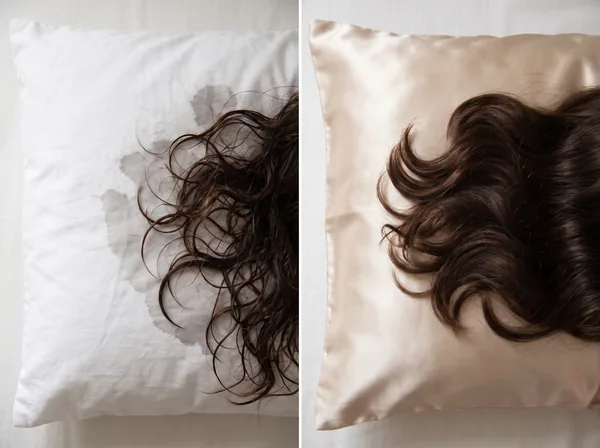
How you sleep affects friction, tangling and style retention. For how much and how well you sleep and its links to shedding, see stress, sleep and hair.
Key takeaways
- No published human trial shows that silk or satin pillowcases reduce breakage, frizz or hair loss. The popular figures, such as "43% less breakage", come from brand-run lab tests.
- The mechanism is plausible. A contract testing lab reports that silk has a lower friction coefficient against hair than cotton, but has published no numbers. Lower friction should mean fewer tangles and less frizz, especially in curly, long or damaged hair. Conditioner or sebum on the hair lowers friction by at least 25% in the same report, so conditioned hair matters as much as the fabric.
- Dermatologists suggest a loose "pineapple" ponytail on top of the head or a loose braid before sleeping, and say satin or silk bonnets or pillowcases may also reduce friction. This is expert opinion.
- Satin is a weave, not a fibre. Polyester satin is the budget way to get a smooth surface. No study compares it with silk for hair. Silk's other marketed benefits are unproven: silk garments failed to improve eczema in a 300-child randomized trial. Thomas 2017
- Avoid going to bed with soaking-wet hair when you can. Wet hair has higher friction and breaks under lower loads, so a night of rubbing on a pillow invites tangles and breakage. Robbins 2007 One lab study links very long wet periods to swelling of the cell membrane complex between hair cells. Lee 2011 Wet hair is also a reported risk factor for white piedra, a rare fungal infection of the hair shaft, in a review of 131 cases. Guerrero-Ponce 2024 The risk from an occasional damp night is small.
- Do not sleep in tight styles; overnight tension adds to traction (see traction and hairstyles).
The science
Combing studies show breakage is driven by friction, snagging and tangling, and is worse when hair is wet, bleached or unconditioned. Robbins 2007 New 2018 A pillowcase rubs hair at low force for hours, but whether that matters clinically has never been measured in people. Brands say silk keeps hair hydrated because cotton absorbs more water; that is a textile property, not a measured hair outcome.
No trials of bonnets, durags or scarves were found. Elastic bands that sit tightly at the hairline add traction. We found no evidence that sleeping with wet hair causes colds, headaches or hair loss.
What it means by hair profile
- Curly or coily (3A-4C): highest benefit for frizz, tangles and keeping definition between washes; use a loose pineapple or braid plus a satin bonnet or pillowcase.
- Wavy (2A-2C): moderate benefit; a loose pineapple preserves waves.
- Long hair, any type: moderate benefit for nape tangles; a loose braid.
- Bleached, relaxed or high-porosity hair: moderate to high, since a damaged cuticle snags more; condition well and avoid sleeping wet.
- Short straight hair: negligible; skip it.
- Fresh blow-out or silk press: a wrap or bonnet helps the style last.
Myths and facts
- Silk pillowcases are clinically proven to reduce breakage: false as stated; brand lab data only.
- Silk is better than satin: untested; both are smooth and polyester satin is cheaper.
- Silk keeps hair hydrated: unproven.
- Never sleep with wet hair: reasonable low-stakes advice; an occasional damp night is not harmful.
- Sleeping on one side causes a bald spot: no evidence in adults.
Practical recommendations
- Go to bed with dry or mostly dry hair when practical. If you must sleep damp, detangle with conditioner first and use a loose braid or bun.
- For curly, coily, long or damaged hair, use a loose pineapple, braid or twists plus a satin or silk bonnet, scarf or pillowcase.
- No tight styles overnight.
- Budget tiers: free (loose braid or pineapple); $ (polyester satin pillowcase or bonnet, about $5-15); $$ (mulberry silk pillowcase, about $30-90, with extra benefit over satin unproven).
Bottom line
A smooth sleep surface is a cheap, low-risk habit that mainly helps curly, long and damaged hair. It is not a hair-loss treatment. Discuss with a doctor.
Studies 5
Thomas KS et al. Silk garments plus standard care compared with standard care for treating eczema in children: A randomised, controlled, observer-blind, pragmatic trial (CLOTHES Trial). 2017
Tested: silk garments vs usual care
Result: Silk garments did not improve eczema.
Read the study ↗Robbins C et al. Hair breakage during combing. III. The effects of bleaching and conditioning on short and long segment breakage by wet and dry combing of tresses. 2007
Result: Dry combing breaks the ends more per stroke; wet combing breaks hair higher up; conditioner reduced both short and long breaks.
Read the study ↗Lee Y et al. Hair shaft damage from heat and drying time of hair dryer. 2011
Tested: air drying vs dryer at 47, 61 and 95 C
Result: No cuticle damage in air-dried hair; every dryer setting cracked cuticle, worse with heat; cell membrane complex bulging only in air-dried hair; qualitative, no statistics.
Read the study ↗Guerrero-Ponce AE et al. Review Article White Piedra: Review of 131 cases. 2024
Result: Wet hair, long hair and hair ties were predisposing factors.
Read the study ↗New S et al. Measuring the frequency of consumer hair combing and magnitude of combing forces on individual hairs in a tress and the implications for product evaluation and claims substantiation. 2018
Result: Women combed about 16 strokes a day; wet bleached hair snagged every time and conditioner cut that to under 10%.
Read the study ↗Related
- Stress, sleep and hairMajor stress can trigger temporary shedding, while everyday stress and poor sleep are weaker, mostly associational links.
- Traction and hairstylesTight, long-worn styles can cause traction alopecia, which reverses if caught early and scars if it is not.
- Hair dryingAir drying is not clearly safer than moderate-heat blow-drying; high heat, close range and heat on wet hair are the real problems.
- Brushing and detanglingMost combing damage comes from tangles, so conditioner and the right technique cut breakage more than the choice of brush.