Topic
Split ends and trimming
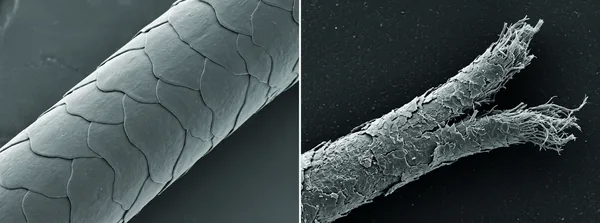
Split ends cannot be repaired, only smoothed over or cut off, and trimming preserves length by stopping splits travelling up the strand.
Key takeaways
- Split ends (trichoptilosis) cannot be repaired. Products can smooth or temporarily glue them, but the only cure is cutting them off.
- A 2024 mechanical study (Trinity College Dublin with L'Oreal) found that in a subject prone to splitting, splits began inside the strand and ran far along it, while in control hair they began at the surface and stayed short. Bleaching the control hair made it behave like the split-prone hair. Taylor 2024
- That suggests a split can travel up the shaft, so waiting may let damage extend. But the study compared one split-prone subject with one control. It is a mechanism study, not a trimming-schedule trial.
- Healthy-looking hair has clean-cut ends or tapered tips. End integrity relates to the cortex, whereas shine and texture relate to the surface. Hair that is repeatedly chemically altered, or intrinsically weak, is most prone to splitting. Sinclair 2007
- Trimming does not speed growth, which happens at the follicle. It preserves length by preventing breakage. We found no trial of trim intervals, so advice like "every 6-8 weeks" is not evidence-based.
The science
The Dublin team built three tests (loop tensile, moving loop, and moving loop fatigue) that simulate tangles during combing. The split-prone hair failed in fewer fatigue cycles, and shear stress along the length was highlighted as the driver of internal microcracks. Taylor 2024 Related fatigue work is covered in bond builders and hair damage.
What it means for your hair
- Curly and coily hair: single-strand knots stress the fibre. Detangle with conditioner and wide-tooth tools (inference from the tangle mechanism).
- Bleached or relaxed hair has the highest risk, so trims are needed more often.
- Fine hair: thin ends look see-through, and trimming improves apparent density.
Myths and facts
- Myth: split-end sealing serums fix splits. They coat the end, and we found no repair evidence.
- Myth: trimming speeds growth. It only affects length retention.
Bottom line
Cut splits rather than hoping to mend them. Reduce the causes with gentle detangling, less heat and bleach, and regular conditioner (see how conditioner works). Silicone or oil on the ends lowers friction between trims (see silicones).
Studies 2
Taylor D et al. The biomechanics of splitting hairs. 2024
Result: Split ends form when hair cycles through tangle-like loops; in bleached or low-quality hair splits start inside the fibre.
Read the study ↗Sinclair RD. Healthy hair: what is it? J Investig Dermatol Symp Proc. 2007
Result: Smooth texture, shine and clean-cut or tapered ends are read as signs of healthy hair.
Read the study ↗Related
- Hair damage: what it is and where it comes fromDamage is cumulative and cannot be biologically healed, and chemical treatments, heat, sun, water and grooming each add to it.
- Bond builders (Olaplex, K18, maleic acid, "acidic bonding")Bond builder is a marketing label for four unrelated chemistries; all have lab results on cut hair and none has a trial on real heads.
- How conditioner worksRinse-off conditioner coats hair with a positively charged layer that cuts friction and tangling; it does not repair structural damage.
- Silicones in hair careSilicones coat hair to cut friction and add shine without repairing it; buildup is real but manageable, and the scare claims are unsupported.