HEAT STYLING
Heat styling without frying your hair
The short answer
Heat damage grows with temperature and with every extra pass. Use the lowest heat that gives the style, only on fully dry hair, with as few passes as possible. A heat protectant helps a little but does not make high heat safe.
See how it works
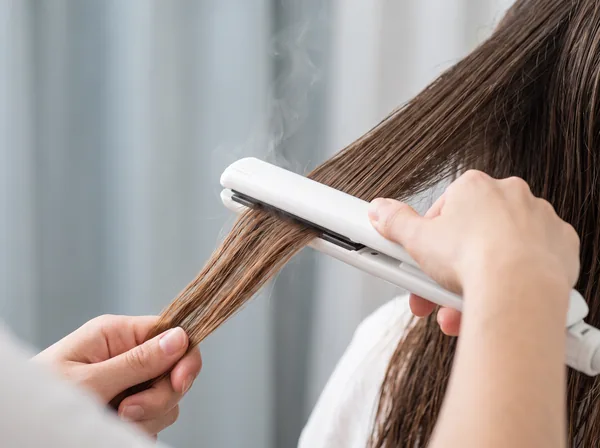
Do this
- 1Dry hair completely first. Never iron damp hair.
- 2Start at a low temperature. Raise it only if the style will not hold.
- 3One or two passes per section. Do not keep going over it.
- 4Apply heat protectant, let it dry fully, then use the tool.
- 5Hair already bleached or relaxed? Use less heat or skip it.
- 6Give your hair heat-free days. Replace any dryer that overheats.
The numbers behind it
-
237 C
Hair protein (keratin) loses its structure at about this temperature. Gases appear from 200 C. Lab test, 3 hair bundles.
-
190-220 C
Between these iron temperatures the number of tiny holes inside the hair rose quickly, and with each extra pass.
-
Wet is worse
Ironing wet hair caused considerably more structural damage than ironing dry hair, with the same chemical damage.
-
Helps a bit
Repeated heat-protection spray reduced one chemical marker of heat damage (loss of an amino acid, tryptophan). It did not stop the structural damage.
For your hair
Fine hair
Thin strands heat through fast. Keep the temperature lowest.
Thick or coarse hair
May need a little more heat to style, but damage still adds up pass by pass.
Curly and coily hair
Heat can loosen curls. Protect the ends and keep straightening occasional.
Bleached or relaxed hair
Treat as already damaged. Heat on top compounds it.
Myths to ignore
-
Myth A heat protectant makes high heat safe.
Truth In a lab test, protectant sprays cut one chemical marker of damage, but structural damage still happened. Lower temperature matters more than the spray.
Christian 2011 ↗ -
Myth Steam or a water-based spray lets you iron damp hair.
Truth Water on hair plus a hot iron gave considerably more structural damage than the same iron on dry hair. Rapid evaporation is the likely cause.
Christian 2011 ↗ -
Myth Bubble hair only happens to already damaged hair.
Truth When researchers heated hair from 16 volunteers, every one of them developed bubbles at high enough heat. It is a dose of heat, not a hair type.
Detwiler 1994 ↗
Made for this
Go deeper
- Heat styling toolsFlat irons, curling tools and hot combs damage hair more with higher temperature, repetition and wet hair; dermatologists advise using them about once a week or less.
- Heat damage and heat protectantsHeat on wet hair is the clearest harm, and there is little independent evidence that retail heat-protectant sprays work.
- Hair damage: what it is and where it comes fromDamage is cumulative and cannot be biologically healed, and chemical treatments, heat, sun, water and grooming each add to it.
- Hair dryingAir drying is not clearly safer than moderate-heat blow-drying; high heat, close range and heat on wet hair are the real problems.
All studies in this guide (4)
Lima CRRC et al. Heat-damaged evaluation of virgin hair. J Cosmet Dermatol. 2019
Tested: laboratory thermal analysis of hair (TG/DSC-MS, FTIR, ATR-FTIR, SEM); no styling tool used
Result: Water was released at 25-170 C, CO2, SCO and H2S from 200 C, and keratin denatured at about 237 C. Asian hair lost more protein than Caucasian hair. Lab thermal analysis, not a styling-tool test.
Read the study ↗Gamez-Garcia M. Void and pore formation inside the hair cortex by a denaturation and super-contraction process occurring during hair setting with hot irons. J Cosmet Sci. 2011
Tested: repeated hot-iron straightening cycles at different temperatures
Result: Frequent iron users had pores and voids (0.1-1.5 micrometres) inside the hair cortex; in the lab the number of pores rose quickly between 190 and 220 C and with more straightening cycles, linked to superheated steam inside the fibre.
Read the study ↗Christian P et al. The effects of water on heat-styling damage. J Cosmet Sci. 2011
Result: Heat styling wet hair caused considerably more structural damage than heat on dry hair, and a water-based heat-protection spray did worse than an ethanol-based one.
Read the study ↗Detwiler SP et al. Bubble hair. Case caused by an overheating hair dryer and reproducibility in normal hair with heat. 1994
Result: Bubble hair traced to an overheating dryer; heating normal hair from all 16 volunteers caused bubbles at high enough heat.
Read the study ↗