DRYING
How to dry your hair without damaging it
The short answer
Wet hair is weaker, so be gentle. Squeeze and blot instead of rubbing. If you use a dryer, keep it about 15 cm away, moving, on low heat. Never put an iron or high heat on damp hair.
See how it works
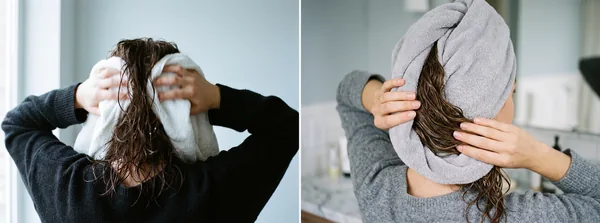
Do this
- 1Squeeze out water with your hands first.
- 2Press with a soft towel, microfiber wrap or old T-shirt. Do not rub.
- 3Detangle only with conditioner in, starting at the ends.
- 4Let hair air dry partly, then finish with a dryer.
- 5Dryer about 15 cm away, always moving, lowest heat that works.
- 6Never use a flat iron or curling iron on damp hair.
The numbers behind it
-
About half
Wet hair fibres were about half as stiff as dry ones. Lab test on cut hair from one batch.
-
17% weaker
Wet untreated hair broke under 17% less pull than dry hair, and stretched further before snapping.
-
47, 61, 95 C
Dryer at 15, 10 and 5 cm from the hair reached these temperatures. Surface damage grew with the heat (30 rounds on lab hair bundles).
-
16 of 16
Hair from all 16 volunteers developed heat bubbles when heated enough. Bubble hair is a heat effect, not a hair type.
For your hair
Fine hair
Dries fast, so wet time is short. The lowest heat is plenty.
Thick or dense hair
Dries slowly. Air dry partly, then finish on moderate heat, keeping the dryer moving.
Curly and coily hair
Scrunch or diffuse on low heat. Rubbing with a towel causes frizz and snags.
Bleached hair
Weakest when wet: twice-bleached wet hair was weaker than wet untreated hair. Use the least heat; handle it with conditioner on.
Myths to ignore
-
Myth Air drying is always the safest way to dry.
Truth Air-dried tresses had no surface cracks, but the authors still judged a dryer at 15 cm, kept moving, as less damaging overall. One small experiment.
Lee 2011 ↗ -
Myth A little heat on damp hair does no harm.
Truth Heat on wet hair can boil water inside the strand and leave gas bubbles that make it snap. A review of 11 cases found most were from heated tools on wet hair.
Li 2023 ↗ -
Myth A microfiber towel prevents damage.
Truth One lab test on over-bleached hair favoured a microfiber wrap (45% vs 17% for cotton). Only 3 repeats, and an author is linked to a microfiber towel brand.
Carvalho 2023 ↗
Made for this
Go deeper
- Hair dryingAir drying is not clearly safer than moderate-heat blow-drying; high heat, close range and heat on wet hair are the real problems.
- Brushing and detanglingMost combing damage comes from tangles, so conditioner and the right technique cut breakage more than the choice of brush.
- Heat damage and heat protectantsHeat on wet hair is the clearest harm, and there is little independent evidence that retail heat-protectant sprays work.
All studies in this guide (5)
Wortmann FJ, Quadflieg JM, Wortmann G. Comparing hair tensile testing in the wet and the dry state. Int J Cosmet Sci. 2022
Result: In untreated hair, wet modulus was 1.89 GPa vs 3.95 GPa dry (about half), wet break stress 191 vs 229 MPa and wet break extension 57.5% vs 46.9%; twice-bleached hair was weaker still when wet (167 MPa, 1.63 GPa). About 30 fibres per tress, 16 tresses, one hair batch, lab study, one co-author at an industry institute. Wet modulus was the best single damage measure and dry break stress a feasible alternative.
Read the study ↗Lee Y et al. Hair shaft damage from heat and drying time of hair dryer. 2011
Tested: air drying vs dryer at 47, 61 and 95 C
Result: No cuticle damage in air-dried hair; every dryer setting cracked cuticle, worse with heat; cell membrane complex bulging only in air-dried hair; qualitative, no statistics.
Read the study ↗Detwiler SP et al. Bubble hair. Case caused by an overheating hair dryer and reproducibility in normal hair with heat. 1994
Result: Bubble hair traced to an overheating dryer; heating normal hair from all 16 volunteers caused bubbles at high enough heat.
Read the study ↗Li YM et al. A review of bubble hair deformity. 2023
Result: Most patients had used a heated tool on wet hair; treatment is stopping the heat.
Read the study ↗Carvalho et al. Comparison of cotton towel, microfiber towel and blow-dryer drying on bleached hair. J Nat Fibers. 2023
Tested: 7-minute cotton towel wrap vs microfiber wrap vs blow-dryer at 60-80 C, 8 repeats
Result: Wear resistance was 45% for microfiber vs 17% for cotton and 10% for the blow-dryer (3 replicates each); an author is affiliated with a microfiber hair-towel brand and no conflict is declared.
Read the study ↗