Topic
Hair structure, from follicle to fiber
The hair you see is dead, hardened keratin made of three layers, which is why care is about protecting it rather than repairing it.
Key takeaways
- A hair fiber has up to three layers: an outer cuticle (overlapping dead cells, about 10% of the weight), a central cortex (86-90% of the weight, where the strength is) and sometimes a medulla, a hollow or loosely packed core that is more common in thicker fibers Plowman 2018.
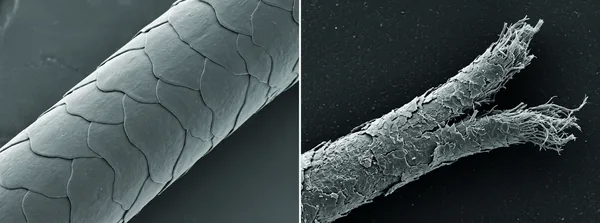
- The cuticle is the face your hair shows the world. Its scales control shine, friction, tangling and how water gets in. It wears away first. In hair longer than 2.4 m, the cuticle wore away progressively over roughly the first metre before the cortex was affected Thibaut 2010.
- One fatty acid, 18-methyleicosanoic acid (18-MEA), is bonded to the outside of cuticle cells and makes the fiber water-repelling. Removing it makes the fiber water-loving, and alkaline treatments are reported to strip it Jones and Rivett 1997.
- The cortex is a composite of stiff keratin filaments in a softer protein matrix. Cross-linking in the matrix keeps the filaments stiff even when wet Greenberg and Fudge 2013.
- The join between cuticle and cortex is a weak point. In stress tests of curly hair from one donor, cracks started there and merged until the fiber snapped, at unpredictable places Camacho-Bragado 2015.
- Breakage is usually cumulative: grooming and environmental stress add up as internal cracks. Gentle handling every day matters more than one rescue product.
- Inner fine structure is nearly identical between people. In 12 people, including twins, X-ray diffraction found the same keratin and lipid signals; only some extra lipid signals differed, and those ran in families Yang 2014.
The follicle makes the fiber
Hair is produced in the follicle bulb and hardens as it rises; by the time it emerges, the cells are dead. The shape of the follicle sets the curve of the fiber (see curl pattern), and the growth cycle is covered in the hair growth cycle. Nothing you apply changes what the follicle already made. Products only change what happens to that fiber afterward, so "repair" claims really mean coating, filling or cross-linking a fixed structure.
Layer by layer
| Layer | Share of fiber | What it is | Why it matters |
|---|---|---|---|
| Cuticle | About 10% by weight | Flat dead cells overlapping like roof tiles, pointing root to tip, with a thin lipid layer on the outside | Shine, friction, tangling, water uptake. First to wear, lift or chip |
| Cortex | 86-90% | Spindle-shaped cells packed with keratin filaments in a protein matrix | Strength, stretch and curl. Damage here (bleach, very high heat) is the serious kind |
| Medulla | Variable | A central column of spaces with air-filled granules | No clear effect on strength; medullated and non-medullated fibers had similar average mechanical properties, but medullated ones were less uniform Wagner and Joekes 2007 |
| Cell membrane complex | Very small | Lipid and protein glue between cells | Holds scales and cortex cells together; where cracks spread |
Bonds that hold keratin together
- Hydrogen bonds are weak and numerous. Water disrupts the protein-protein ones, which is why hair set wet and dried holds its shape until it gets wet again Harland 2022.
- Disulfide bonds are strong and permanent. Perms, relaxers and bleach act on them. Under tension some break first near the protein ends, and this differs between wet and dry fibers (a sheep wool study, not human hair) Harland 2022.
Water and the fiber
Hair absorbs water and swells. In a tensile study of bleached and unbleached hair given heat treatments, wet-state stiffness (modulus) was judged the best single measure of damage from chemical and physical treatments Wortmann 2022. Calcium and magnesium from hard water build up in the cuticle, more so in chemically damaged hair, and stiffen the fiber. Style retention improved in virgin hair but dropped slightly in bleached hair Evans 2011 (industry-affiliated authors).
How hair ages from root to tip
In very long virgin hair, the cuticle wore away over about the first metre while the cortex stayed intact. Further along, scale damage was significant and lined up with falling ceramide and 18-MEA levels. Most mechanical and optical properties then decayed Thibaut 2010 (industry-funded). This is why ends look and feel worse than roots even without styling damage, and why trimming is the only true fix for old ends.
Lipids
A 2023 systematic review of 59 papers found that hair lipid composition varies by ancestry-linked hair type and by layer, and that lipid loss is accelerated by bleach, dye, perms, straightening, surfactants, sun and aging, leading to dehydrated, breakable, dull hair Csuka 2023. Lab studies on African hair found more, and more disordered, cuticle lipids and faster water diffusion Marti 2016, Oliver 2020, Barba 2022. Between Caucasian, Asian and African samples no difference in inner fiber structure was found, while geometry, mechanics and water swelling did differ Franbourg 2003. More in hair by ancestry.
What it means for your hair
- Curl pattern: bends concentrate stress. See curl pattern and brushing and detangling.
- Strand thickness: coarse fibers are more likely to have a medulla. See strand thickness.
- Porosity: in practice a marker of cuticle and lipid-layer damage. See hair porosity.
- Length: longer hair has had more exposure. Assume ends older than a couple of years are cuticle-worn.
Myths and facts
- "Hair can be repaired." Largely false, because the fiber is dead. Products can smooth, coat or add temporary cross-links; see bond builders.
- "Curly hair is a different kind of keratin." Not supported at the nanoscale Franbourg 2003, Yang 2014. Geometry and surface lipids differ.
- "Breakage is one bad event." More often it is cumulative internal cracking Camacho-Bragado 2015.
Practical points
- Treat the ends as the oldest, most worn part of the fiber. Expect them to need more conditioning and eventual trimming.
- Keep wet-hair mechanical stress low: detangle gently with conditioner slip.
- Avoid stacking chemical and heat damage. They add up.
- Be skeptical of any "rebuilds the cortex from the outside" claim that shows no penetration and strength data.
- If hair breaks near the scalp or comes out with a white bulb, think shedding or scalp rather than fiber damage.
Bottom line
Hair is dead keratin: protect it, don't expect to repair it. The cuticle wears first, breakage accumulates, and the ends are always the oldest part. Inner structure is much the same across people; what differs is shape, surface lipids and history of treatment. Several of the key studies are small or industry-funded, so treat the details as a good working model rather than settled fact.
Studies 15
Plowman JE, Harland DP. Fibre Ultrastructure. Adv Exp Med Biol. 2018
Result: The cuticle is about 10% of fiber weight and the cortex 86-90%; a medulla is more common as fibers get thicker.
Read the study ↗Yang FC, Zhang Y, Rheinstadter MC. The structure of people's hair. PeerJ. 2014
Result: X-ray diffraction found the same keratin and lipid signals in all people studied; only some extra lipid signals differed, and these ran in families.
Read the study ↗Jones LN, Rivett DE. The role of 18-methyleicosanoic acid in the structure and formation of mammalian hair fibres. Micron. 1997
Result: 18-methyleicosanoic acid is bonded to the outside of cuticle cells and makes hair water-repellent; alkaline treatments strip it, leaving a water-attracting surface.
Read the study ↗Thibaut S et al. Chronological ageing of human hair keratin fibres. Int J Cosmet Sci. 2010
Result: In hair longer than 2.4 m the cuticle wore away over roughly the first metre; further out, scale damage lined up with falling ceramide and 18-MEA levels and mechanical properties decayed.
Read the study ↗Greenberg DA, Fudge DS. Regulation of hard alpha-keratin mechanics via control of intermediate filament hydration: matrix squeeze revisited. Proc Biol Sci. 2013
Result: Cross-linking in the protein matrix keeps keratin filaments stiff even when the hair is wet.
Read the study ↗Harland DP et al. The susceptibility of disulfide bonds to modification in keratin fibers undergoing tensile stress. Biophys J. 2022
Result: Water disrupts protein hydrogen bonds, and under tension some disulfide bonds break first near the protein ends, differently wet and dry (sheep wool, not human hair).
Read the study ↗Show 9 more studies
Camacho-Bragado GA, et al. Understanding breakage in curly hair. Br J Dermatol. 2015
Result: In curly hair from one donor, cracks started at the cuticle-cortex junction and grew under grooming stress until the fiber snapped; a 2005 survey found 96% of African-American women reported breakage.
Read the study ↗Wagner R, Joekes I. Hair medulla morphology and mechanical properties. J Cosmet Sci. 2007
Result: Medullated and non-medullated fibers had similar average mechanical properties, but medullated fibers were less uniform.
Read the study ↗Franbourg A et al. Current research on ethnic hair. J Am Acad Dermatol. 2003
Result: No difference in the fine structure of Caucasian, Asian and African fibers, while geometry, mechanics and water swelling differed.
Read the study ↗Wortmann FJ, Quadflieg JM, Wortmann G. Comparing hair tensile testing in the wet and the dry state. Int J Cosmet Sci. 2022
Result: In untreated hair, wet modulus was 1.89 GPa vs 3.95 GPa dry (about half), wet break stress 191 vs 229 MPa and wet break extension 57.5% vs 46.9%; twice-bleached hair was weaker still when wet (167 MPa, 1.63 GPa). About 30 fibres per tress, 16 tresses, one hair batch, lab study, one co-author at an industry institute. Wet modulus was the best single damage measure and dry break stress a feasible alternative.
Read the study ↗Evans AO, Marsh JM, Wickett RR. The structural implications of water hardness metal uptake by human hair. Int J Cosmet Sci. 2011
Result: Calcium and magnesium from hard water concentrate in the cuticle, more in chemically damaged hair, and stiffen the fiber; style retention improved in virgin hair but dropped slightly in bleached hair.
Read the study ↗Csuka DA et al. A systematic review on the lipid composition of human hair. Int J Dermatol. 2023
Result: Hair lipid composition varies by hair type and layer, and lipid loss is accelerated by bleach, dye, perms, straightening, surfactants, sun and aging.
Read the study ↗Marti M et al. The influence of hair lipids in ethnic hair properties. Int J Cosmet Sci. 2016
Result: African hair had more, and more disordered, cuticle lipids and higher water permeability; removing apolar lipids reduced permeability and raised strength in the African fibers tested.
Read the study ↗Oliver MA et al. Ethnic hair: thermoanalytical and spectroscopic differences. Skin Res Technol. 2020
Result: East Asian hair resisted hydration changes most and had very low cuticle lipids, European hair took up the most water, and African hair had the fastest water diffusion.
Read the study ↗Barba C et al. Lipid distribution on ethnic hairs by FTIR synchrotron spectroscopy. Skin Res Technol. 2022
Result: Lipid distribution differed between Asian, African and Caucasian hair, with more disordered cuticle lipids in African hair.
Read the study ↗Related
- The hair growth cycleEvery scalp follicle cycles through growth, shutdown, rest and release on its own clock, which explains normal shedding, seasonal changes, maximum length and how pattern hair loss works.
- Curl patternHow straight, wavy, curly or coily your hair is gets decided in the follicle, mostly by genes, and it shapes shine, tangling, breakage and how a routine should be built.
- Hair porosityPorosity describes how easily water moves in and out of a hair fiber; in practice it is mostly a marker of damage, and the popular float test does not measure it.
- Strand thicknessThickness is the width of a single hair strand, separate from how many strands you have, and it changes how hair feels, styles, breaks and ages.
- Hair by ancestry, what differs and what overlapsHair differs on average between populations in curl, width, density and surface lipids, but the overlap is large and the old three-box labels hide more than they show.
- Hair elasticity and the home stretch testHair stretch and strength fall with damage, but the popular home stretch test has never been validated.
- Bond builders (Olaplex, K18, maleic acid, "acidic bonding")Bond builder is a marketing label for four unrelated chemistries; all have lab results on cut hair and none has a trial on real heads.
- Brushing and detanglingMost combing damage comes from tangles, so conditioner and the right technique cut breakage more than the choice of brush.