Topic
Hair elasticity and the home stretch test
Hair stretch and strength fall with damage, but the popular home stretch test has never been validated.
Key takeaways
- Labs measure hair stretch by pulling single fibers until they break, recording stiffness (modulus), how far the fiber stretches (break extension) and the force at breaking (break stress) Wortmann 2022.
- Wet hair is softer and stretchier than dry hair. Water loosens protein hydrogen bonds Harland 2022, while cross-linking keeps the filaments stiff Greenberg and Fudge 2013. In a bleach-plus-heat study, wet modulus was the best single damage measure and dry break stress a feasible alternative Wortmann 2022.
- Stretch and strength fall with damage. A 6-point heat damage scale built from eight wet single-fiber measures tracked how people perceived damage on hair tresses Shaw 2025 (hair-tool industry lab, UK).
- Heat on wet hair is harder on the fiber. Heat styling wet hair caused considerably more structural damage than heat on dry hair, and a water-based heat-protection spray caused more damage than an ethanol-based one in one study Christian 2011.
- No single number predicts breakage. In curly hair, fibers fail through accumulated internal cracks at the cuticle-cortex junction, so a hair can look and stretch normally and still be close to failing Camacho-Bragado 2015.
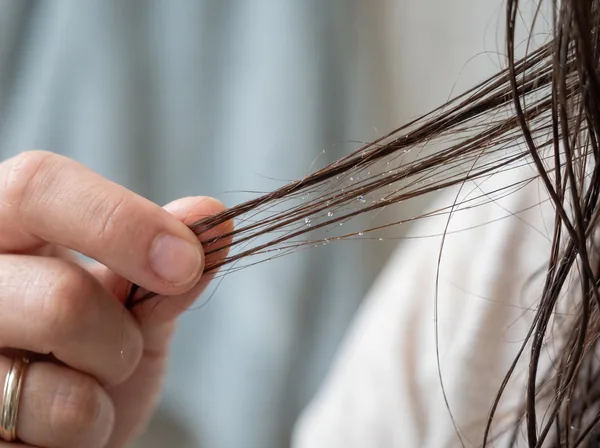
- The common home test has no published validation. Consumer sites describe stretching a wet strand and watching whether it snaps or stretches about 30% or 50% and recovers, but none cite a study.
- Each test damages the strand tested, and results depend on wetness, length, thickness and chemical history.
What "elastic" means for a hair
Under a pull, a hair first stretches almost like a spring and returns when released. Then it yields and stretches with permanent change, and finally it breaks. Labs summarize the curve with three numbers:
| Measure | What it means | In damaged hair |
|---|---|---|
| Modulus | Stiffness: force needed for a small stretch | Falls with damage in wet testing Wortmann 2022 |
| Break extension | How far the fiber stretches before it breaks | Used as a damage indicator |
| Break stress | Force at breaking | Feasible damage measure when dry |
Dry and wet results were only weakly related for modulus but strongly related for break extension and break stress, so a dry test and a wet test are not interchangeable for stiffness Wortmann 2022.
Why water changes everything
Keratin filaments sit in a cross-linked matrix. Water loosens the hydrogen bonds between proteins so the filaments slide more easily, but the disulfide cross-links remain and keep the hair together Harland 2022, Greenberg and Fudge 2013. In practice, wet hair is easier to stretch and set, and easier to break if you pull too hard. That is why shaping, curling and detangling behave differently on wet and dry hair.
Elasticity and curl
Tightly curled hair has many bends and twists, and part of what looks like stretch is the helix straightening rather than the material stretching. No study we opened measured whether coily hair has a different material elasticity from straight hair, so comparing curl patterns by stretch test is not supported. What is documented is that curly fibers from one donor failed through crack growth at the cuticle-cortex junction after accumulated stress Camacho-Bragado 2015.
Damage and elasticity
- Chemical plus heat: in bleached and unbleached tresses given the same heat treatments, the chemical and heat effects were mostly additive Wortmann 2022.
- Aging along the length: mechanical properties of long hair decayed significantly beyond roughly the first metre as the cuticle failed Thibaut 2010.
What it means for your hair
- Fine strands have less cross-section and so lower breaking force overall. See strand thickness.
- High-porosity or heavily processed hair tends to have lower wet stiffness and more breakage. See hair porosity.
- Curly and coily hair: stretch tests are hard to read because of coil geometry. Use breakage history and tangling instead.
Myths and facts
- "Elasticity tells you whether you need protein or moisture." No study we opened supports this. Lab data only show that damage lowers stretch and strength.
- "Healthy wet hair stretches 50% and bounces back." A frequently quoted rule of thumb with no study behind it.
- Fact: wet hair is easier to damage with heat, so avoid straightening or curling hair that is still damp Christian 2011.
Practical points
- Treat elasticity as a damage clue. Snapping when gently stretched wet, plus many short broken pieces, flags chemical or heat damage, especially with a history of bleach or frequent hot tools.
- If you try the home test, use a few hairs that shed naturally or came out in a comb, wet them, stretch gently and do it once.
- History (bleach, relaxer, heat frequency, trim dates) tells you more than a stretch test.
- Dry hair fully before flat-ironing. If you must apply protectant to damp hair, one study favored an ethanol-based one Christian 2011.
- If hair snaps within a few centimeters of the scalp, consider shedding or a scalp issue; see the hair growth cycle and hair loss scales.
Bottom line
Damage lowers stretch and strength, and wet hair is the vulnerable state. The home stretch test is unvalidated, so use it, at most, as one clue next to your treatment history. Evidence here is mostly lab work on small samples.
Studies 7
Wortmann FJ, Quadflieg JM, Wortmann G. Comparing hair tensile testing in the wet and the dry state. Int J Cosmet Sci. 2022
Result: In untreated hair, wet modulus was 1.89 GPa vs 3.95 GPa dry (about half), wet break stress 191 vs 229 MPa and wet break extension 57.5% vs 46.9%; twice-bleached hair was weaker still when wet (167 MPa, 1.63 GPa). About 30 fibres per tress, 16 tresses, one hair batch, lab study, one co-author at an industry institute. Wet modulus was the best single damage measure and dry break stress a feasible alternative.
Read the study ↗Greenberg DA, Fudge DS. Regulation of hard alpha-keratin mechanics via control of intermediate filament hydration: matrix squeeze revisited. Proc Biol Sci. 2013
Result: Cross-linking in the protein matrix keeps keratin filaments stiff even when the hair is wet.
Read the study ↗Harland DP et al. The susceptibility of disulfide bonds to modification in keratin fibers undergoing tensile stress. Biophys J. 2022
Result: Water disrupts protein hydrogen bonds, and under tension some disulfide bonds break first near the protein ends, differently wet and dry (sheep wool, not human hair).
Read the study ↗Shaw N et al. Application of single hair fibre tensile measurements to create an industry-standard heat damage scale for hair. Int J Cosmet Sci. 2025
Result: A 6-point heat damage scale built from eight wet single-fiber measures tracked how people perceived damage on tresses.
Read the study ↗Christian P et al. The effects of water on heat-styling damage. J Cosmet Sci. 2011
Result: Heat styling wet hair caused considerably more structural damage than heat on dry hair, and a water-based heat-protection spray did worse than an ethanol-based one.
Read the study ↗Camacho-Bragado GA, et al. Understanding breakage in curly hair. Br J Dermatol. 2015
Result: In curly hair from one donor, cracks started at the cuticle-cortex junction and grew under grooming stress until the fiber snapped; a 2005 survey found 96% of African-American women reported breakage.
Read the study ↗Show 1 more studies
Thibaut S et al. Chronological ageing of human hair keratin fibres. Int J Cosmet Sci. 2010
Result: In hair longer than 2.4 m the cuticle wore away over roughly the first metre; further out, scale damage lined up with falling ceramide and 18-MEA levels and mechanical properties decayed.
Read the study ↗Related
- Hair structure, from follicle to fiberThe hair you see is dead, hardened keratin made of three layers, which is why care is about protecting it rather than repairing it.
- Hair porosityPorosity describes how easily water moves in and out of a hair fiber; in practice it is mostly a marker of damage, and the popular float test does not measure it.
- Strand thicknessThickness is the width of a single hair strand, separate from how many strands you have, and it changes how hair feels, styles, breaks and ages.
- The hair growth cycleEvery scalp follicle cycles through growth, shutdown, rest and release on its own clock, which explains normal shedding, seasonal changes, maximum length and how pattern hair loss works.
- Hair loss scales, hairlines and how to classify your own hair lossThe Norwood, Ludwig, Sinclair and BASP scales describe pattern hair loss in broad bands, and this page explains how reliable they are, how well people can stage themselves and how to tell a mature hairline from a receding one.